AHS: 13 Official Podcast Episode 4: Paul Anthony Kelly and Anu Schwartz
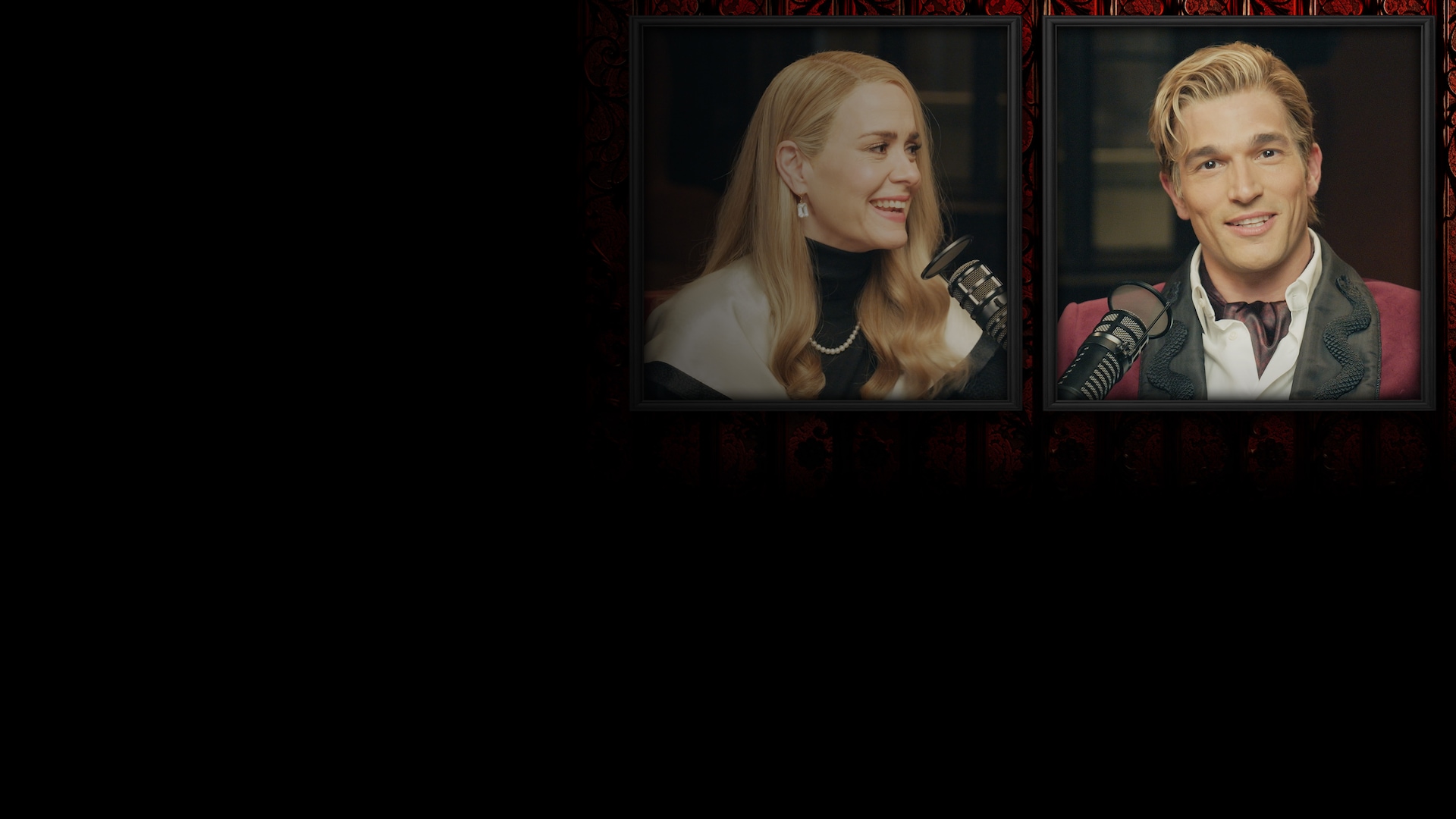
PODCAST
AHS: 13 Official Podcast
EPISODE 4
AHS: 13 OFFICIAL PODCAST
PAUL ANTHONY KELLY AND ANU SCHWARTZ



PODCAST TRANSCRPIT
EPISODE 4: PAUL ANTHONY KELLY AND ANU SCHWARTZ
PAUL ANTHONY KELLY: Welcome to the official AHS 13 podcast. I'm Paul Anthony Kelly, and I can't wait to dive into American Horror Story, back for its 13th chapter. It's an AHS fanatic's dream, with the return of fan favorite characters and a terrifying new storyline where the number 13 brings something far more sinister than a little bad luck.
Today I'm here with Anu Schwartz, the production designer. How are you, Anu?
ANU SCHWARTZ: Great. How are you doing?
PAUL ANTHONY KELLY: I'm doing very well, thank you. When did you first start w- in the Ryan Murphy universe?
ANU SCHWARTZ: It goes way back, actually. I was an art director on a movie with Ryan called The Normal Heart- Okay ... that he directed. So I'd met him then, and then, um, wound up working on The Politician and took over the season designing, which was an amazing experience in and of itself. That's when I really understood that there's a whole universe- within even The Politician, even though it's not American Horror Story, there's always... The stories that are told through the Ryan Murphy Productions is, has always taps into something within the collective conscious or the zeitgeist, and that's the storytelling that I can really dig into as a visual storyteller.
PAUL ANTHONY KELLY: Well, yeah, the visual storytelling in something like this is such a huge component.
ANU SCHWARTZ: It's like a mirror-
PAUL ANTHONY KELLY: Mm-hmm ...
ANU SCHWARTZ: being held up to our whole society of, like, our fears, our desires our, you know, our anxieties.
And American Horror Story was already running at that time, so these were, you know, these are a lot of side projects that happened, but they always have this thread of tapping into a sort of collective consciousness within America.
PAUL ANTHONY KELLY: Yeah.
ANU SCHWARTZ: For me, this is, uh, as a designer, has been one of the most interesting experiences to really hone the craft-
PAUL ANTHONY KELLY: Sure
ANU SCHWARTZ: of what we do-
PAUL ANTHONY KELLY: Yeah ...
ANU SCHWARTZ: in visual storytelling. There's a certain visual language that y- you need to sort of follow-
PAUL ANTHONY KELLY: Absolutely ...
ANU SCHWARTZ: um, and create spaces that are grand and-
PAUL ANTHONY KELLY: You don't say ...
ANU SCHWARTZ: uh, operatic.
PAUL ANTHONY KELLY: Yeah.
ANU SCHWARTZ: Um, knowing the, the lensing, just the photography alone, wide, low, high, lo- you know, everything is... There's no detail that you spare in sets like this.
PAUL ANTHONY KELLY: No rock left unturned.
ANU SCHWARTZ: No. So I knew I had to do that and live up to that. Um, so it's been a lot of fun.
PAUL ANTHONY KELLY: Like, yeah, absolutely, and, and you seem to be very successful at it, so thank you for your work.
ANU SCHWARTZ: Thank you.
PAUL ANTHONY KELLY: So can you describe the set that we're in today for this podcast?
ANU SCHWARTZ: I mean, the best way to describe it is it's the devil's penthouse.
For most of the architecture that I think we were going for in the design, it's, um, it's a neoclassic, Gothic apartment-
PAUL ANTHONY KELLY: Mm-hmm ...
ANU SCHWARTZ: in New York.
PAUL ANTHONY KELLY: Apartment, this thing's like a palace.
ANU SCHWARTZ: Yeah. We set off to create this set that encapsulated this season's storyline, but then we wanted to hide a lot of Easter eggs within the set-
PAUL ANTHONY KELLY: Mm-hmm ...
ANU SCHWARTZ: that would reference other visuals from past seasons. That process first started with, you know, me reading the scripts.
PAUL ANTHONY KELLY: Yep.
ANU SCHWARTZ: It just popped right off the page. Mm. You know, um, and knowing the sort of level of detail and scale that it needed to be was an interesting challenge.
PAUL ANTHONY KELLY: Yeah.
ANU SCHWARTZ: And in conversations with Ryan, he wanted to make sure that we were adding these, these elements that the fans can really recognize and dig into.
PAUL ANTHONY KELLY: Mm-hmm.
ANU SCHWARTZ: Um-
PAUL ANTHONY KELLY: The Easter eggs.
ANU SCHWARTZ: The Easter eggs.
PAUL ANTHONY KELLY: Yeah. Could you describe some of these Easter eggs?
ANU SCHWARTZ: You know, we've hidden 13 everywhere within the set architecturally. Um, you wouldn't know it, but the ceilings are 13 feet tall. Yeah. Right away when you walk in, you'll see this chandelier-
PAUL ANTHONY KELLY: Mm-hmm ...
ANU SCHWARTZ: which was custom designed by my decorator, Rich Murray, and I.
And we took elements of sacred geometry. There is the Romanesco, uh, vegetable which is widely known as a great example in nature of fractal geometry and the Fibonacci sequence. So that is an element that's placed right in the center of this chandelier that cascades down with 13 helix-shaped sconces that are hanging.
The dining room has a wallpaper, shells in the Fibonacci sequence. There are 13 beams in there.
PAUL ANTHONY KELLY: Really?
ANU SCHWARTZ: The rotunda, when you walk in, the floor has, um, what's called a Metatron, which is a, uh, s- another sacred geometry. Mm-hmm. 13 circles, which forms the Merkabah, which is another sacred geometry. So it became almost gospel of like, "Okay, 13.
Okay, what... You know, what's the answer to this question? 13."
PAUL ANTHONY KELLY: 13. Yeah.
ANU SCHWARTZ: You know? So my team and I have just had so much fun-
PAUL ANTHONY KELLY: Oh, I'm sure ...
ANU SCHWARTZ: with all of those ideas. So really, like, any set that we created in the, in the series has some thought behind it reflecting either past seasons or 13 or the whole Fibonacci sequence, which was such an important element in the story.
That is sort of everywhere, and that reflects the sacred geometry in the lighting and in the flooring, in the ceiling, um, in the furniture. There's been a lot of thought behind all of that going into it. And it really, like, a- again, it just, it starts from, you know, being able to operate in this world of, like, immense creativity-
PAUL ANTHONY KELLY: Mm-hmm
ANU SCHWARTZ: and having fun.
PAUL ANTHONY KELLY: Yeah. Yeah, I mean, you have to have fun.
ANU SCHWARTZ: Yeah.
PAUL ANTHONY KELLY: But it sounds like you're having a lot of fun doing the research, putting in the Easter eggs. Yeah. There are quite a few I've noticed. It's, it's kinda fun to see. You catch it every day at work. Yeah. Yeah.
ANU SCHWARTZ: Now, can I ask you a couple questions?
PAUL ANTHONY KELLY: I mean- Sure.
ANU SCHWARTZ: For you, the work that you've done, uh, on Love Story is in a way very opposite of this world. You know, as, for an actor, when you walk onto a set like this-
PAUL ANTHONY KELLY: Mm-hmm ...
ANU SCHWARTZ: as opposed to the sets from Love Story, how did it make you feel? Walking in and how did that affect maybe your performance?
PAUL ANTHONY KELLY: Oh, uh, but that's a great question.
Thank you. I think what I'm doing or what I'm able to do on this set in AHS 13, uh, and my character, walking into the sets that you've created definitely helped solidify my choices. Um, I wasn't sure what I was gonna do. You know, with John and Love Story, it was very recreating an ethos of a person, and that's kind of an already lived experience, and those sets are already there.
I mean, all the things we shot outside in New York, of course we dressed it up like the '90s, but, um, it helped inform the character choices as where I could make them. But in something like this where it is kind of f- more free reign for character building, I think the costumes and the set design definitely help.
The first time I walked into the set in particular, I was flabbergasted at just the level and attention to, to detail on everything. The, the fireplaces, the gate on the fireplace, the furniture around. It's all so tactile, and you're able to just live in this totally fabricated reality, and it just becomes more fun and playful.
And I think for me as an actor and being allowed to make choices and take bigger swings and, you know, this character is definitely different from what I did before, it helps immensely, so thank you.
ANU SCHWARTZ: I'm glad you mentioned costumes because, um, the work that Lou and Catherine and the team have done, you know, I, I always like to say I want the actor to feel like they're wearing the set-
PAUL ANTHONY KELLY: Of course
ANU SCHWARTZ: in, in that sense. Yeah. So, so I'm glad to hear that you had that experience.
PAUL ANTHONY KELLY: Oh, yes.
ANU SCHWARTZ: And that's what we always strive for. And again, like, the w- the costumes too, y- I had to feel like, feel like I had to live up to, to that standard, you know? There's so many bars- ... to live up to in this, in this, uh, world.
But at the same time, it's also, like, very creatively, um, liberating because- Sure ... you know, traditional storytelling in, in visual language in filmmaking tends to follow a certain level of, you know, designing to, uh, to story always. But in this world, s- the story is just filled with so much magic and- ... like, terror and- so you tend to bre- you can break these rules, you know? You can move outside of traditional methods of how we do our work.
PAUL ANTHONY KELLY: Yeah.
ANU SCHWARTZ: Um, and you know, Ryan gives us freedom to do that. Um, and if it's, if it's right and you hit it, it's great. He'll definitely let you know if it's not right. And you know, but that's...
It's all sort of like swirling around the, the kind of- energy of it all is sort of swirling around you- Yeah, for sure ... as you're, like, doing the work. I actually had a dream about the, the maid's pantry.
PAUL ANTHONY KELLY: Okay.
ANU SCHWARTZ: That it should be, like... And this is what I mean, is like I feel like once you enter this world, you're, like, almost being consumed by it.
PAUL ANTHONY KELLY: Yeah, for sure.
ANU SCHWARTZ: I had this dream that it should be, like, up a staircase.
PAUL ANTHONY KELLY: Mm-hmm.
ANU SCHWARTZ: Of course, there's always f- physical challenges with building-
PAUL ANTHONY KELLY: Sure ...
ANU SCHWARTZ: sets and things like that, and timeframes, and money- ... and all that regular stuff. But I was like, "Okay, what if we made it, like, a few steps up and a turn into a room?"
PAUL ANTHONY KELLY: Mm-hmm.
ANU SCHWARTZ: And so I got to work, like, visualizing it, and presented it to Ryan, and he was like, "Yes, great. Run with it." So it's like those kinds of things where it's not on the page. It's not in anyone's conversations that we've had, but it was like, it just kinda, like, came to me.
PAUL ANTHONY KELLY: And a vision you could make a reality.
ANU SCHWARTZ: Yeah.
PAUL ANTHONY KELLY: Yeah.
ANU SCHWARTZ: That's the environment that we're working in that I find exciting.
PAUL ANTHONY KELLY: It's very conducive to creativity.
ANU SCHWARTZ: Yeah.
PAUL ANTHONY KELLY: Yeah. It's fun. So you're living your dream job.
ANU SCHWARTZ: I really am.
PAUL ANTHONY KELLY: Yeah. I love to hear it.
ANU SCHWARTZ: I mean, it's really hard sometimes.
PAUL ANTHONY KELLY: Of course.
ANU SCHWARTZ: But-
PAUL ANTHONY KELLY: But anything worth doing is never easy.
ANU SCHWARTZ: True. And I have a great-
PAUL ANTHONY KELLY: You're doing a bang-up job.
ANU SCHWARTZ: Thank you. I have a great team of people- that do amazing work, and you can't do it without them.
PAUL ANTHONY KELLY: That's one thing- You really can't ... I've noticed about now being in, in the Murphyverse, is he's very loyal to his people, and those people and their people, everyone is A-level, top-notch, loves what they do, comes in, there's never a sad face.
People are ready to do the work. And it's, again, like this creative community. It doesn't work unless everyone's all in it, and everyone's all in it. Yeah. It's really, it's a special place to be.
ANU SCHWARTZ: Yeah.
PAUL ANTHONY KELLY: You know?
ANU SCHWARTZ: Yeah.
PAUL ANTHONY KELLY: Well, that's all for this time. Be sure to rate, review, and follow the official AHS13 podcast. You can check it out on Hulu or Hulu on Disney+ for bundle subscribers, or wherever you get your podcasts. And watch new episodes of AHS13 on Hulu or FX.